
Publications
Integrating subsurface geothermal assessment with surface energy planning: a multidisciplinary methodology for heat network development
Barns, D., Van Alstine, J., Gouiza, M., Ryan-Smith, J., Bramham, E., Loveridge, F., Bale, C., Dyuti Sarkar, A., Rees, S., Shaw, R., (2026)
Heat zoning frameworks emerging across Europe assess heat demand and network viability using surface-level indicators but lack subsurface geothermal resource data. Separately, geological assessments of urban geothermal potential are rarely connected to energy planning or stakeholder decision-making. This paper presents a multidisciplinary methodology which bridges these domains, combining geological modelling, geospatial energy analysis, GIS-based spatial integration, and stakeholder co-design through a decision theatre. The methodology translates probabilistic geological estimates into planning-compatible formats, overlays them with building stock, heat demand and development data to identify spatial alignments and mismatches, and tests integrated proposals through structured stakeholder engagement. We applied this integrated approach across three contrasting potential heat network zones in Leeds, UK: an established city centre with existing district heating, a greenfield development area, and a mixed existing settlement. In each case, the integrated methodology generated context-sensitive proposals which no single-domain analysis could provide. In the city centre, it revealed a viable geothermal resource beneath an incumbent network whose commercial model could not accommodate it. This led to proposals for new networks beyond the existing system. In the greenfield zone, overlaying subsurface potential with the development pipeline revealed a closing temporal window, with homes being consented above viable aquifers using incompatible heating systems. In the existing settlement, the methodology identified misclassified anchor loads that altered the viability assessment for network development. These findings demonstrate that integrating subsurface and surface data within planning processes reveals resource opportunities, development conflicts and implementation barriers invisible when geological assessment and energy planning are conducted independently. The integration logic is transferable to contexts where geological and surface-level planning data are available.
How can governance alignment unlock geothermal resources for urban heat decarbonisation?
Barns, D., Van Alstine, J., Gouiza, M., Ryan-Smith, J., Bramham E., Loveridge, F., Bale, C., Dyuti Sarkar, A., Rees, S., Shaw, N. (2026)
Heat network zoning has emerged as a key governance instrument for urban heat decarbonisation. However, its implementation requires integration with spatial planning systems and comprehensive assessment of available heat sources. This paper examines how vertical (cross-scale) and horizontal (cross-sector) governance misalignment shapes prospects for integrating geothermal resources into heat network zones. Through geological modelling, geospatial analysis of planning decisions and stakeholder engagement in Leeds, UK, we identify a pattern of dual exclusion, where open-loop geothermal capacity sufficient to meet over 90% of heat demand mostly falls outside statutorily designated heat network zones, whilst within zones, planning approvals for incompatible heating systems are creating carbon lock-in which rules out future network connection. We find that these outcomes are systematically produced by governance architecture which fragments decision-making across scales and sectors, where national heat zoning proceeds without subsurface resource data whilst lacking statutory weight in local spatial planning. We propose an integrated governance framework and three policy reforms linking heat network zoning, spatial planning and subsurface resource management to address resource exclusion and prevent carbon lock-in in urban heat decarbonisation programmes.
Opportunities and costs for shared ground loops
Barns, D.G., Bale, C., Turner, J.L., Loveridge, F., Rees, S., Fletcher, M. (2026)
This paper explores the potential of shared ground loops (SGLs) as a low-carbon heating solution for UK homes, particularly in medium-density urban areas where individual heat pumps or large heat networks are not practical. Through analysis of case studies, policy frameworks, stakeholder input, and cost data, the authors found that SGLs can provide efficient, flexible, and potentially cost-effective heat decarbonisation, especially for retrofit projects, but their wider adoption is currently constrained by high upfront costs, limited policy support, and underdeveloped business models. The paper concludes that stronger policy recognition and new delivery models are needed for SGLs to play a larger role in the UK's transition to net-zero heating.
Complex Systems Mapping of Sustainable Cooling Landscape in Pune
Basu, S., Bale, C. (2025)
Two systems maps are created through a participatory systems mapping method to offer a bird’s eye view of the complexities of the cooling system landscape in the city of Pune, India. These maps serve as the shared bedrock for all actions on cooling decarbonization in the city by a wide range of stakeholders.
These maps of the current system, as understood by the local system participants from within, serve as a heuristic framework/ mental model for policymakers to appreciate the interconnectedness of a single socio-technical system. It is possible to focus attention on particular areas of interest in the map while keeping the entire landscape in view. Policymakers should be able to identify areas of priority, levers of change, collaborative networks for policy assistance, and gauge implications for other policy arenas.
Learning from other cities: Transfer learning based multimodal residential energy prediction for cities with limited existing data
Sheng, Y., Arbabi, H., Ward, W.O.C., Mayfield, M. (2025)
Reliable prediction of residential energy consumption is essential for informing energy efficiency policies and retrofit strategies. However, traditional data-driven approaches are often constrained by the availability and quality of data. This study presents a novel approach combining multimodal neural networks with a transfer learning framework, leveraging both tabular and visual data to enhance prediction accuracy and enable knowledge transfer from data-rich to data-poor regions. Case studies conducted in Barnsley, Doncaster, and Merthyr Tydfil demonstrated that the proposed approach outperforms traditional mono-modal models. The multimodal model improved prediction accuracy significantly, achieving a MAPE reduction from 1.15 (with only visual data) and 0.86 (with only tabular data) to 0.43 (with both visual and tabular data), while the inclusion of transfer learning offers further performance improvements in data-scarce regions, with up to 63.6 % error reduction. Explainable AI is utilised to validate the model’s interpretability, confirming key features such as floor and wall insulation conditions as pivotal in energy consumption predictions. This integrated framework offers actionable insights for policymakers, facilitating data-driven decisions to enhance energy efficiency in diverse urban settings.
City-scale residential energy consumption prediction with a multimodal approach
Sheng, Y., Arbabi, H., Ward, W.O.C., Álvarez M.A., & Mayfield, M. (2025)
The key role of buildings in tackling climate change has gained global recognition. To avoid unnecessary costs and time wasted, it is important to understand the conditions and energy usage for existing housing stock to identify the most important features affecting energy consumption and to guide the relevant retrofit measures. This paper investigated how the spatial, morphological and thermal characteristics of residential houses contribute to housing energy consumption. Additionally, it presents a rapid assessment tool using minimum data input to answer two main questions: 1) What type of properties may need retrofit? 2) What building elements/features may be prioritised to be retrofitted?
A case study was performed with around 143,000 residential properties in Sheffield. An automated machine approach was applied which successfully estimated the energy consumption of target buildings with an \(R^2\) score of 0.828. Permutation feature importance and partial dependence of the features were examined against energy consumption. The results indicate that housing sizes and conditions of the external walls are found to be the most important features when estimating the energy consumption of residential buildings in Sheffield. Relatively larger and older detached houses in neighbourhoods with higher build density may benefit the most from home upgrading projects for energy consumption reduction.
An analytical framework to examine power in sustainable energy decision-making in cities
Basu, S. (2024)
Urban areas are emerging as “strategic sites” in the ongoing sustainable energy (SE) transitions. This has rekindled the importance of urban governments in initiating this transition urgently, a departure from the actors managing more mainstream centralized energy governance. However, while there is a growing international and academic interest in urban energy transitions, the political presence of cities in the global clean energy landscape remains largely underwhelming. Scholars studying urban energy transitions or governance have often pointed toward the lack of material and knowledge capacities of the urban governments as the key barrier for their muted actions. I argue that decision-making by urban governments with respect to clean energy adoption needs deeper inspection wherein aspects such as capacity, or the lack of it, are symptoms of underlying power contestations and conflicts that are negotiated in multi-level governance systems. The scholarship of power captures the ideas of contestation, control, and acquiescence, going beyond the ideas of cooperation prevalent in multilevel governance. In this article, I juxtapose these with concepts from multi-level governance and socio-technical studies to offer an analytical framework for understanding energy decision-making by city governments. The framework presented in this article attempts to capture both direct and indirect forms of power, their operationalization, and manifestation in constituting identities, actual decisions (and indecisions) as well as the conditions of decision-making. I also use the framework to understand the role of power in sustainable energy decision-making in three cities in India as an illustration of possible application of the framework.
A framework for exploring futures of complex urban energy systems
Basu, S., Bale, C.S.E. (2023)

Futures cone (Voros, 2003)
In order to address the climate crisis and provide citizens with clean, secure and affordable energy, urban energy systems need to transition. This is significant as urban energy systems are increasingly seen as complex systems for their close interactions with local urban society, while being interdependent with higher levels of governance. Decisions taken today will continue to influence the inhabitants of our cities for well over 50 years, locking in energy consumption patterns of the future. How, then, do we make decisions on the interventions needed to bring about a desirable future, and prepare for the probable and possible futures? In this paper, we consider the key characteristics of urban energy systems from a complexity science perspective in order to explore what methodologies in futures and foresight scholarship could be beneficial in supporting urban energy decision-making. To do this we have undertaken an integrative review—a method that allows review, synthesis, critique, and analysis of new and emerging topics across multiple disciplines and multiple literature types—and consider the findings in light of their usefulness in understanding complex systems, which are inherently uncertain. We consider how futures and foresight theories and methods can be applied in urban and energy studies, highlighting examples of where around the world these have been applied by organizations seeking to shape transitions. The many methods and approaches that exist under the futures’ umbrella have not been applied to anywhere near their full potential in urban energy studies, despite the limitations of many of the planning and modelling exercises currently used. We use key learnings from existing futures and foresight scholarship, along with our understanding of urban energy systems as complex adaptive systems, to propose a theoretical and practical framework for exploring their futures. The framework encompasses concepts of futures, contextualization, mapping uncertainty, participatory processes, and futures governance. Although there is much further research work needed to test and operationalize this framework in an applied way with city stakeholders, we hope this charts a way forward in addressing the critical challenges faced by urban energy planners and their partners.
Important social and technical factors shaping the prospects for thermal energy storage
Barns, D.G., Taylor, P.G., Bale, C.S.E., Owen, A. (2021)
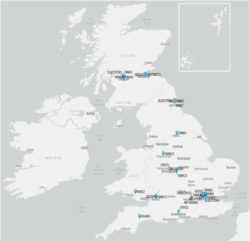
Map showing geographical location of UK thermal energy storage projects (Reproduced from Ordnance Survey map data by permission of the Ordnance Survey© Crown Copyright 2020)
Thermal energy storage is likely to be integral to a sustainable, secure and affordable energy system facing ever greater challenges in matching supply and demand. Techno-economic studies have explored the potential for thermal storage deployment, but transitions in the energy system are also influenced by the activities and decisions of an array of actors. We gathered new empirical evidence from a desk-based survey on thermal energy storage in the UK and through a sociotechnical analysis explored the status and role of thermal storage in the energy transition. We find the technology remains a relatively niche approach in the UK subject to complex national and local policy and governance arrangements and the impacts of a stable fossil-based heating regime benefitting from significant lock-in effects. Whilst we acknowledge the limitations of a focus on single technology-systems to deliver the transformative energy system change required, we find thermal storage delivering both local and national benefits to support system balancing and mitigate seasonal peaks in demand, whilst having the potential to deliver other benefits. Promising innovations in business models are helping to enable thermal storage deployment, and these are also applicable to low carbon heat provision more widely.
A complexity approach to defining urban energy systems
Basu, S., Bale, C.S.E., Wehnert, T., Topp, K. (2019)
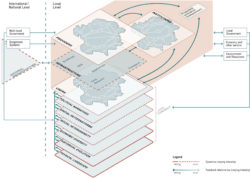
Urban energy complex system framework (complete).
Urban energy systems have been commonly considered to be socio-technical systems within the boundaries of an urban area. However, recent literature challenges this notion in that it urges researchers to look at the wider interactions and influences of urban energy systems wherein the socio-technical sphere is expanded to political, environmental and economic realms as well. In addition to the inter-sectoral linkages, the diverse agents and multilevel governance trends of energy sustainability in the dynamic environment of cities make the urban energy landscape a complex one. There is a strong case then for establishing a new conceptualisation of urban energy systems that builds upon these contemporary understandings of such systems. We argue that the complex systems approach can be suitable for this. In this paper, we propose a pilot framework for understanding urban energy systems using complex systems theory as an integrating plane. We review the multiple streams of urban energy literature to identify the contemporary discussions and construct this framework that can serve as a common ontological understanding for the different scholarships studying urban energy systems. We conclude the paper by highlighting the ways in which the framework can serve some of the relevant communities.