
Energy and Complexity Conference 2025
Energy & Complexity 2025: Towards a new complex-systems research agenda for a just energy transition

Held in Leeds on 22 January 2025, the Energy & Complexity Conference brought together more than 100 researchers, policymakers and practitioners from across the UK and beyond to explore the application of complexity science to energy systems and the transition to Net Zero. Building on a national conference hosted by the UK Energy Research Centre in 2012, the event provided a platform for discussion of new research, emerging methods and future priorities for the field.
The conference featured keynote presentations, early-career researcher lightning talks, knowledge cafés and a panel discussion, helping to shape an updated research agenda at the intersection of energy systems and complexity science.
Thank you to everyone who attended and contributed to the discussions. A summary of the event and key outcomes is available in our news article. The event had a dedicated Padlet page with questions and thoughts from the days discussions.
The conference provided opportunities for participants to:
- Engage with the energy and complexity community
- Hear from prominent academics and others engaged in using complexity science to address energy challenges
- Learn about new frameworks, perspectives, methods and application areas
- Connect with other researchers to develop future collaborative work
- Consider the impact of complexity perspectives on policy- and decision-making for energy futures
- Help us develop a research agenda for the intersection of these two fields.
The conference explored the following themes:
- The intersection of complex systems and energy research
- Exploring the interdisciplinary nature of the field, with a focus on the roles of social science and modelling and engineering perspectives
- Setting out current energy challenges and the need for complexity science (including practitioner perspectives)
Conference programme
The Conference was held at Horizon Leeds on the 22nd January 2025.
Keynote presentations
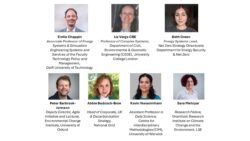
- Embracing Complexity: Simulating the Energy Transition - Dr Émile J. L. Chappin, TU Delft
- Net Zero Systems: Embedding Systems Thinking in UK Government - Beth Green, Department for Energy Security & Net Zero
- Complex Systems Thinking and Decarbonisation - Prof Liz Varga, University College London
Early-Career Researcher (ECR) Lightning Talks
- Presentations showcasing emerging research at the intersection of energy systems and complexity science.
Knowledge Cafés
- Interactive discussions focused on developing a research agenda for energy and complexity research.
Panel Discussion
- What should the priorities be for complexity science in energy policy and practice over the next five years?
- Our panellists were:
- Abbie Badcock-Broe, National Grid
- Peter Barbrook-Johnson, University of Oxford
- Kavin Narasimhan, University of Warwick
- Prof Tim Foxon, Professor of Sustainability Transitions, Science Policy Research Unit, University of Sussex
Networking
- Opportunities for attendees to connect and discuss future collaborations.
For a summary of the discussions and key outcomes from the event, please see our post-event news article.
Contact
For any queries please email us at [email protected] or contact Dr Catherine (Frin) Bale the conference chair: [email protected]
Conference Chair
Dr Catherine Bale, Associate Professor in Sustainable Urban Energy Systems, Sustainability Research Institute, University of Leeds
Steering Group
- Dr Sumedha Basu, Research Fellow, Sustainability Research Institute, University of Leeds
- Prof Tim Foxon, Professor of Sustainability Transitions, Science Policy Research Unit, University of Sussex
- Dr Kavin Narasimhan, Assistant Professor, Centre for Interdisciplinary Methodologies (CIM), University of Warwick
- Prof Liz Varga, Professor of Complex Systems, Head of UCL’s Infrastructure Systems Institute, University College London
Acknowledgement of funding
This conference was funded by a fellowship from the Engineering and Physical Sciences Research Council, EP/R024197/1: Co-creating visions and pathways for integrated urban heat systems.